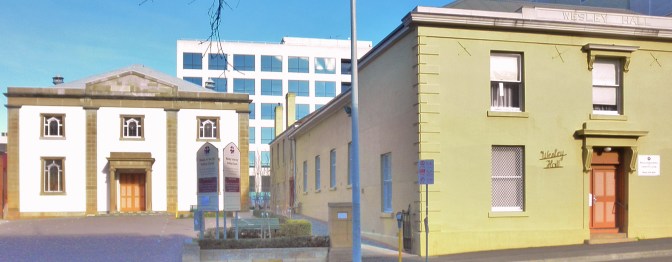
Many of our older church buildings are listed on heritage registers kept by our State and Territory governments. Not all of them have remained “places of worship” or have continued to be put to “liturgical use”. Wesley Hall, Hobart, Tasmania (pictured in the foreground above) is such a place.
Although it was the meeting place for the Wesleyan Methodist Congregation in Hobart from 1825, its primary role ceased, when the “Centenary Chapel” (then the largest Methodist building in the Southern Hemisphere with seating for 1,100 – pictured at rear) opened in 1840. Wesley Hall was put to use as a Mechanics Institute; and today, primarily provides accommodation for a range of office, dance, martial arts and community activities – only occasionally being put to liturgical use.
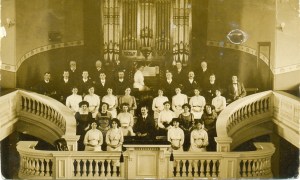
Increasingly, congregations are finding that the set up of their older worship places is less than satisfactory for contemporary forms of liturgy and worship.
Boxed wooden pews, crowded gallery overhangs, acoustic resonating pulpits and convict-era seating may be charming in their own way; but might not meet the needs of contemporary worship leaders or of the congregations participating in worship.
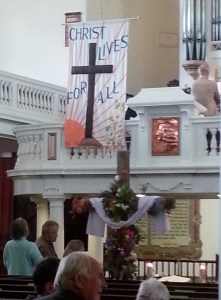 Eventually, someone suggests a change. “Pull out the pews; Install new sound and lighting; Throw out the pulpit; Clear a dance space!” And the suggestions are met with howls of protest.
Now the problem is that not all the howling comes from the congregation.
Congregations, whose buildings are heritage-listed, might find that their proposals meet with opposition from government heritage regulators or local planning authorities – some of whom might be miffed to find that they were not consulted or that their approval was not sought! Mention of “prosecution” and “penalty units” might leave Church Councils and Boards feeling … nervous.
The congregations, for their part, might be equally miffed to be told that approval of some State authority, was needed. After all, aren’t they entrusted with doing the work of the Kingdom? And didn’t they talk about it and reach consensus first? “It’s all in the minutes – somewhere. I don’t think that pulpit is ours anyway. And that boom gate is definitely going in. Don’t care what anybody says!”
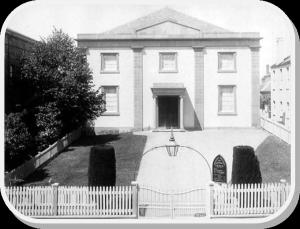 Now the thing is, that we are rarely anything more than custodians of our public and cultural heritage. It is hard to own it or to exercise dominion as though it really belonged exclusively to us.
So if we’re talking about changing some part of the fabric of our heritage-listed places, then we need to know the rules – or at least to know that there are rules – and that they work for everyone’s benefit.
In later posts, we’ll begin to set out some of the rules that apply in Australia. We’ll look at the “liturgical use” exemption (which sometimes means that congregations don’t need special heritage approval to make changes to their heritage-listed worship places); and we’ll point out why, even though we may be part of a national church, we have to operate under several different systems.
ACW


Leave a comment